Posted by Hussain Shabbir On: Tuesday, September 1, 2026
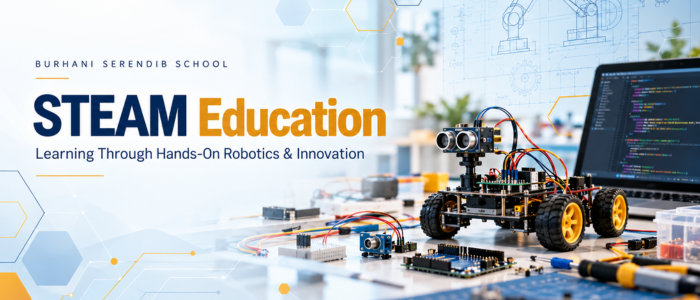
STEAM Education: Learning Through Hands-On Robotics & Innovation
At our school, learning goes beyond textbooks and classrooms.
Through our STEAM Education Initiative, students are given opportunities to explore Science, Technology, Engineering, Arts, and Mathematics through practical, hands-on projects that connect classroom concepts with real-world applications.
Our approach combines robotics, coding, electronics, engineering, design, environmental science, and creative thinking, allowing students to learn by building, testing, improving, and creating.
Rather than simply learning how technology works, our students are encouraged to design and engineer solutions of their own.
🤖 From Learning to Building
Our STEAM programme introduces students to age-appropriate technologies and engineering concepts through practical projects.
Students learn to work with:
- Microcontrollers and embedded systems
- Sensors and electronic circuits
- Robotics and automation
- Coding and computational thinking
- IoT and smart systems
- Mechanical design and prototyping
- Data collection and analysis
- Creative product design
Every project encourages students to move through the engineering process — identify a problem, develop an idea, build a prototype, test it, troubleshoot it, and improve it.
🔐 Form 3: Engineering the History of Telecommunications
Our Form 3 students explored the fascinating world of telecommunications and Morse Code, but instead of simply studying its history, they engineered their own working solution.
As part of their STEAM learning, students designed and built Morse Code Readers using microcontrollers, custom circuitry, tactile inputs, displays, and creatively designed enclosures.
The project brought together technology and history while exploring how communication, codes, and the transmission of knowledge have shaped societies throughout history.
What students explored:
- Smart logic to distinguish dots and dashes using timing
- Microcontroller programming and code interpretation
- Electronic circuits and tactile input switches
- LCD/OLED display integration
- Product design and enclosure construction
- Creative design inspired by “Spy Gadgets” and “Detective Devices”
The project demonstrated how coding, electronics, history, creativity, and cultural understanding can come together within one learning experience.
🧼 Form 2: Automatic Soap Dispenser
Our Form 2 students took a familiar everyday problem and turned it into an engineering challenge.
As part of their STEAM curriculum, students designed and constructed an Automatic Soap Dispenser, integrating sensors, circuitry, mechanical components, and creative product design.
Through the project, students explored:
- Basic electronic circuits
- Sensor technology
- Automation
- Mechanical design
- Product prototyping
- Problem-solving
- Teamwork and collaboration
The project allowed students to apply classroom concepts to a practical hygiene solution while developing the mindset of young engineers and innovators.
🌱 Form 3: Smart IoT Irrigation System
Our students also explored how technology can contribute to sustainable agriculture and responsible use of resources.
The Form 3 Smart IoT Irrigation System combines sensors, programming, electronics, and environmental science to create an autonomous irrigation solution.
The system collects real-time information such as soil moisture and environmental conditions and uses this data to determine when irrigation is required.
Through this project, students explored:
- Real-time sensor data collection
- Soil moisture monitoring
- Temperature and environmental sensing
- Automated decision-making
- IoT concepts
- Pump and motor control
- Water conservation
- Sustainable agriculture
This project demonstrates how students can use technology not simply for automation, but to address real-world environmental challenges.